Bayesian Signal Processing

I have worked on recasting a number of traditional signal processing methods, such as independent component analysis, mixture modelling and autoregressive models, into a Bayesian estimation framework. This provides model selection criteria for determining, eg. the optimal number of components, modes or filter lags.

More recent work has focussed on robust estimation methods, and algorithms for finding nested oscillations. This is of interest to neuroscientists as, for example, the nesting of gamma bursts (30-80Hz) within theta oscillations (4-8Hz) is thought to underlie aspects of short term memory.
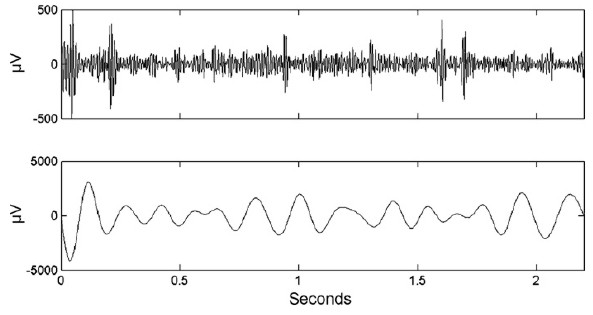
The picture above shows burst of gamma activity aligned with theta troughs in ECOG data.

This work has involved collaborations with Steve Roberts (Oxford), Uta Noppeney (Tuebingen and Birmingham), Kai Miller and Jeff Ojemann (Washington State).

  • W D Penny, E Duzel, K J Miller, and J G Ojemann. Testing for nested oscillation. . J Neurosci Methods, 174(1):50-61, 2008.


  • L. Harrison, W.D. Penny, and K.J. Friston. Multivariate Autoregressive Modelling of fMRI time series. NeuroImage, 19(4):1477-1491, 2003.


  • M.J. Cassidy and W.Penny. Bayesian nonstationary autogregressive models for biomedical signal analysis. IEEE Transactions on Biomedical Engineering, 49(10):1142-1152, 2002.


  • W.D. Penny and S.J. Roberts. Bayesian Multivariate Autoregresive Models with structured priors. IEE Proceedings on Vision, Image and Signal Processing, 149(1):33-41, 2002.


  • S.J. Roberts and W.D. Penny. Variational Bayes for Generalised Autoregressive models. IEEE Transactions on Signal Processing, 50(9):2245-2257, 2002.


  • W.D. Penny and S.J. Roberts. Dynamic models for nonstationary signal segmentation. Computers and Biomedical Research, 32(6):483-502, 1999.